Houdini Swap Might Have Found What Solana DEXs Are Missing
By Pratik Bhuyan Updated August 31, 2026

Summary
- Houdini Swap is building a privacy layer for DeFi transactions rather than competing with DEXs on liquidity or execution
- Its integrations with Jupiter, Solflare and 40 plus other partners let users access privacy without changing how they trade
- Houdini has processed around $2.5 billion in cumulative volume and generated about $13 million in 2025 revenue
Introduction
If DeFi has become what it is today, Ethereum certainly laid the foundation. But much of DeFi’s explosive growth came with the rise of Solana.
Jupiter now dominates Solana's DEX landscape, while Raydium remains one of the network’s biggest liquidity hubs. Together, they show just how important Solana has become to the broader DeFi economy. So when another swap product starts gaining traction, the obvious question is: what does it actually do differently?
Houdini Swap has a surprisingly good answer. Rather than competing with the platforms that optimize where and how a trade executes, Houdini is building a privacy layer around the transaction itself. Users can access Houdini’s privacy features directly, while integrations with platforms such as Jupiter, Solflare and others allow that same privacy layer to extend into the places where users already trade.
The privacy feature is the real product
Most crypto users have become accustomed to the idea that blockchain activity is public. You connect your wallet, approve a transaction, make a swap and move on. But the wallet does not move on. Its entire history remains visible.
Houdini's Private Swap is designed specifically to break that connection. Instead of simply executing one onchain swap from Wallet A to Wallet B, Houdini uses two separate non-custodial exchange routes with a randomized Layer 1 asset acting as an intermediary.
The first exchange handles the deposit side, while a separate exchange handles the destination side. Houdini says the two legs are designed so that neither exchanges nor blockchain observers can establish a complete connection between the original sender and the final recipient.
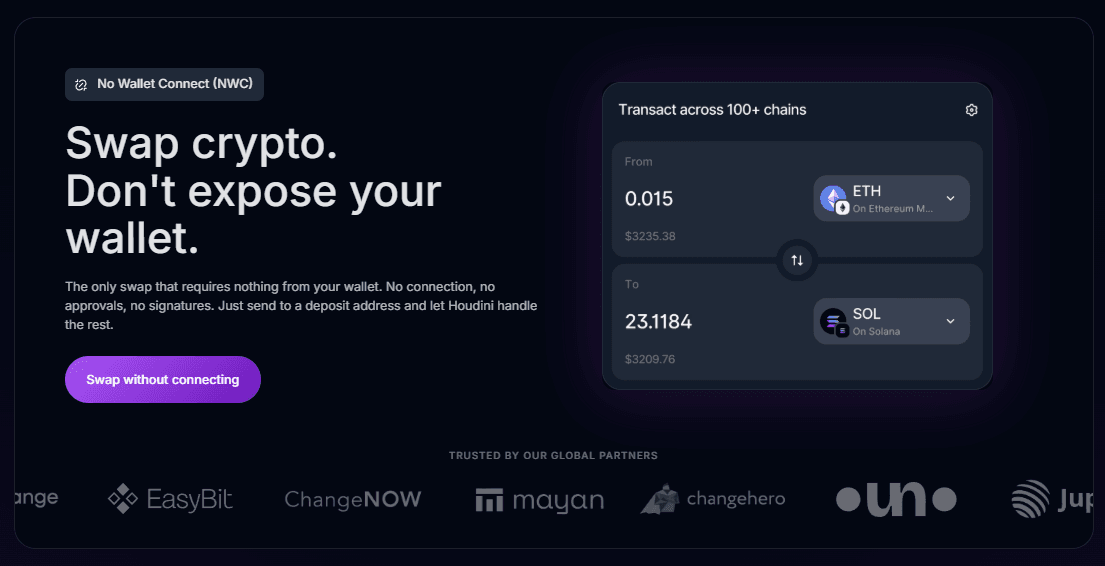
Houdini also offers a No Wallet Connect (NWC) mode, where users send assets to a unique deposit address rather than connecting their wallet or signing a smart contract interaction. That removes the direct wallet-to-protocol connection, although Houdini itself acknowledges that this provides less privacy than its full Private Swap because an observer may still correlate the deposit and subsequent transfer.
How Houdini is taking privacy across DeFi
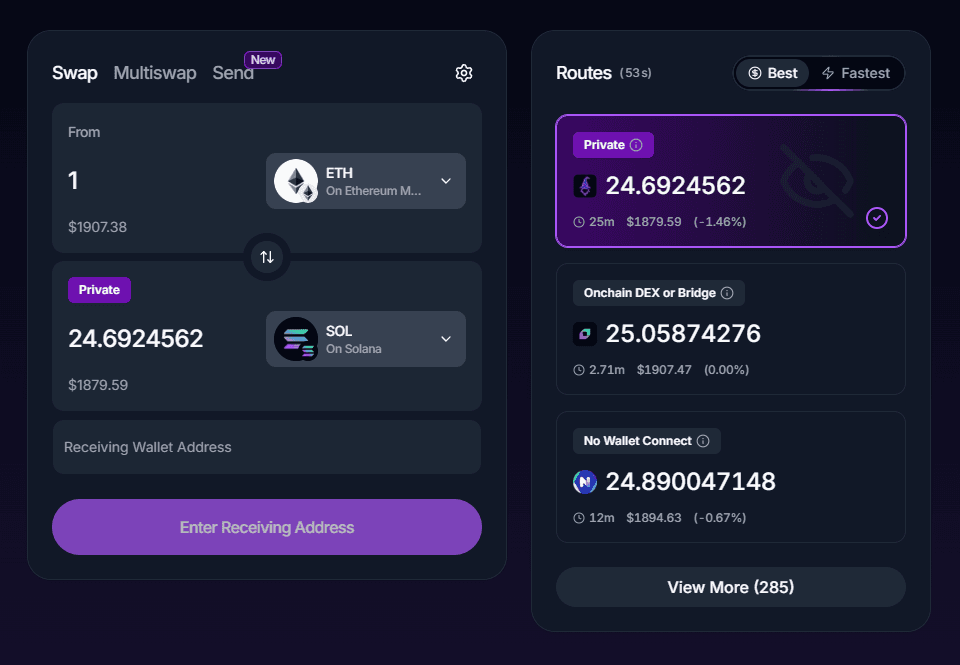
Houdini has built a cross-chain aggregation layer that can route transactions across 100+ networks and thousands of tokens. Its onchain routing can query more than 20 DEXs, bridges and other liquidity protocols, including Jupiter, Uniswap, SushiSwap, Mayan and others. It also connects to centralized exchange partners when those routes make sense.
In March 2026, Jupiter selected Houdini as the router powering its private swaps, and Solflare launched Solana's first wallet-native Privacy Aggregator with Houdini as its debut provider behind an optional Private Send toggle. Maestro, Bloom, Bungee and Jumper have integrated it as well.
Houdini's partner count passed 40 by mid-June, which means a trader can get the same privacy layer from inside the interface they already use rather than being asked to move somewhere new to get it.
Then came the $18 million exit
This is probably the part of the Houdini story that deserves more attention.
In May 2026, SOL Strategies announced that it would acquire Houdini Swap for $18 million, and the deal closed on June 1. The consideration included cash, a promissory note and shares, with an additional earn-out of up to $10 million tied to future EBITDA performance.
At the time of the deal, Houdini had processed roughly $2.5 billion in cumulative volume and generated approximately $13 million in revenue in 2025. More than half of its trailing 12-month volume had touched Solana, making the acquisition particularly relevant to SOL Strategies' strategy of expanding beyond staking and validator infrastructure into transaction and privacy infrastructure.

Why traders should be paying attention
The biggest reason Houdini is worth watching is that privacy is becoming harder to ignore.
As wallets become increasingly tied to identity, analytics platforms get better at clustering addresses and onchain traders become more sophisticated, blockchain transparency starts working both ways. It gives users verifiability, but it also creates a permanent record of their financial behavior.
Most major DEXs have spent years optimizing the first half of the equation: liquidity, execution, speed and cost. Houdini is attacking the other half, which could very well end up being its wedge into a much bigger swap business.
Want more info like this directly in your inbox? Subscribe to The Beluga Brief where we break down such trends and a whole lot more!
Join the Beluga Brief
Dive deep into weekly insights, analysis, and strategies tailored to you, empowering you to navigate the volatile crypto markets with confidence.
Never be the last to know
and follow us on X