Is Venice Crypto’s First Working AI Product?
By Pratik Bhuyan Updated May 20, 2026

Summary
- Venice may be the clearest proof yet that crypto can power a real AI product people actually use.
- It offers top AI models in one privacy-first platform with no email, card, or wallet required to get started.
- With over 2M users and millions of monthly visits, Venice is growing on product demand rather than pure hype.
A Quick Intro
For the last couple of years, crypto projects have slapped “AI” onto everything. Nearly every new project claimed to be building autonomous agents, decentralized compute networks, or some form of onchain intelligence.
But most of it turned out to be empty hype, which only fueled the debate over whether AI + crypto was a genuine use-case or just another round of buzzwords.
And then Venice happened, which may have finally shown that it is possible. Its token, VVV, is up more than 1,500% since its December 2025 low of around $0.90, pushing its market cap past $750 million.
So is Venice worth all the hype? Let’s find out.
So, What Is Venice?
Venice was launched in May 2024 by Erik Voorhees, a long-time advocate for privacy and self-custody who previously founded ShapeShift. We covered when it first launched, you can read more about it here.
The platform is designed as a privacy-focused alternative to mainstream AI services. Instead of building its own foundation models, Venice aggregates many of the best models available today and presents them through a single interface.
When you use venice.ai, it feels much closer to a real AI product than a typical crypto app. You can access models like Claude, GPT, DeepSeek, Mistral, Llama, Grok, Qwen, Kimi, and Gemma from one place. It also supports image generation, video tools, coding, text-to-speech, and even music.
The best part for many users is that the free tier does not ask for an email or card. You get 25 text prompts and 15 image generations per day without signing up.
Why People Care About It
The privacy angle is a big reason Venice stands out.
Your prompts are not stored on Venice’s servers. Chats live in local browser storage and are encrypted. The system also uses different privacy layers, including anonymized routing, zero-retention for self-hosted open-source models, secure enclave infrastructure, and client-side encryption.
The tradeoff is obvious. If you log in from a different device, your chat history does not follow you. But for users who care about privacy, that is exactly the point.
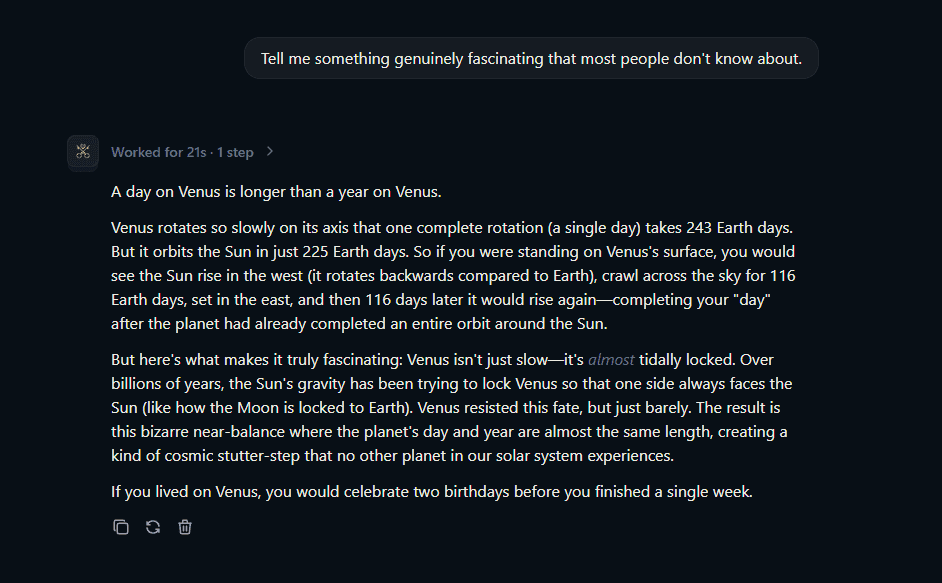
AI interaction interface on Venice, Source: Venice.ai
The Usage Metrics That Stand Out
The strongest argument in Venice's favor is that people are actually using it.
By April 2026, the platform had surpassed 2 million registered users and was seeing around 50,000 daily active users. Monthly traffic exceeded 8 million visits, and the platform was handling thousands of inference requests every hour.
These are meaningful numbers for a relatively young AI platform, especially one that has grown largely through organic interest rather than aggressive marketing.
In a sector where many token valuations are based on future promises, Venice already has measurable product activity.
The Numbers Behind the Hype
What makes Venice different from most crypto-AI projects is that people are actually using it. By April 2026, Venice had more than 2 million registered users, around 50,000 daily active users, and roughly 15,000 inference requests per hour. Monthly traffic had also climbed past 8 million visits.
The token is used primarily for staking. Users who stake VVV receive access to a proportional share of Venice's compute capacity and can earn additional rewards.
In August 2025, Venice introduced DIEM, a token representing $1 per day of API credits in perpetuity. DIEM can only be minted by locking staked VVV, which ties token demand to actual API usage.
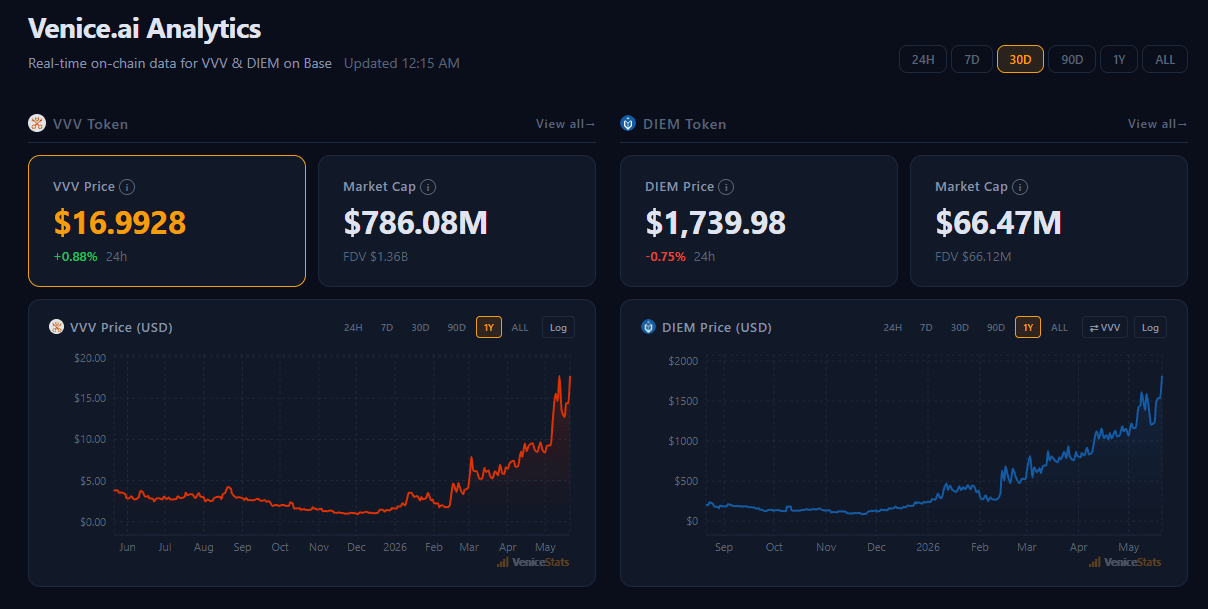
VVV token stats, Source: VeniceStats
But, What Drove the Recent Surge?
Several developments helped push VVV higher over the past few months:
- Emission Reductions
Venice has repeatedly lowered annual token emissions, reducing inflation and tightening supply over time.
- Revenue-Funded Buybacks and Burns
A portion of subscription revenue is used to purchase VVV from the open market and permanently remove it from circulation. More than 33 million tokens, roughly 42% of the original supply, have already been burned.
- OpenClaw Integration
In March 2026, OpenClaw named Venice as a recommended model provider. This was one of the clearest signs that external developers were adopting the platform's API.
- Venice Studio
Launched in April 2026, Venice Studio combines image, video, and audio tools into a unified creative workspace. The feature expanded Venice from a chat platform into a broader AI content suite.
- $27 Million Developer Incentive Program
Venice also announced a $27 million fund to encourage developers to build on its OpenAI-compatible API, accelerating ecosystem growth and increasing tokenized API usage.
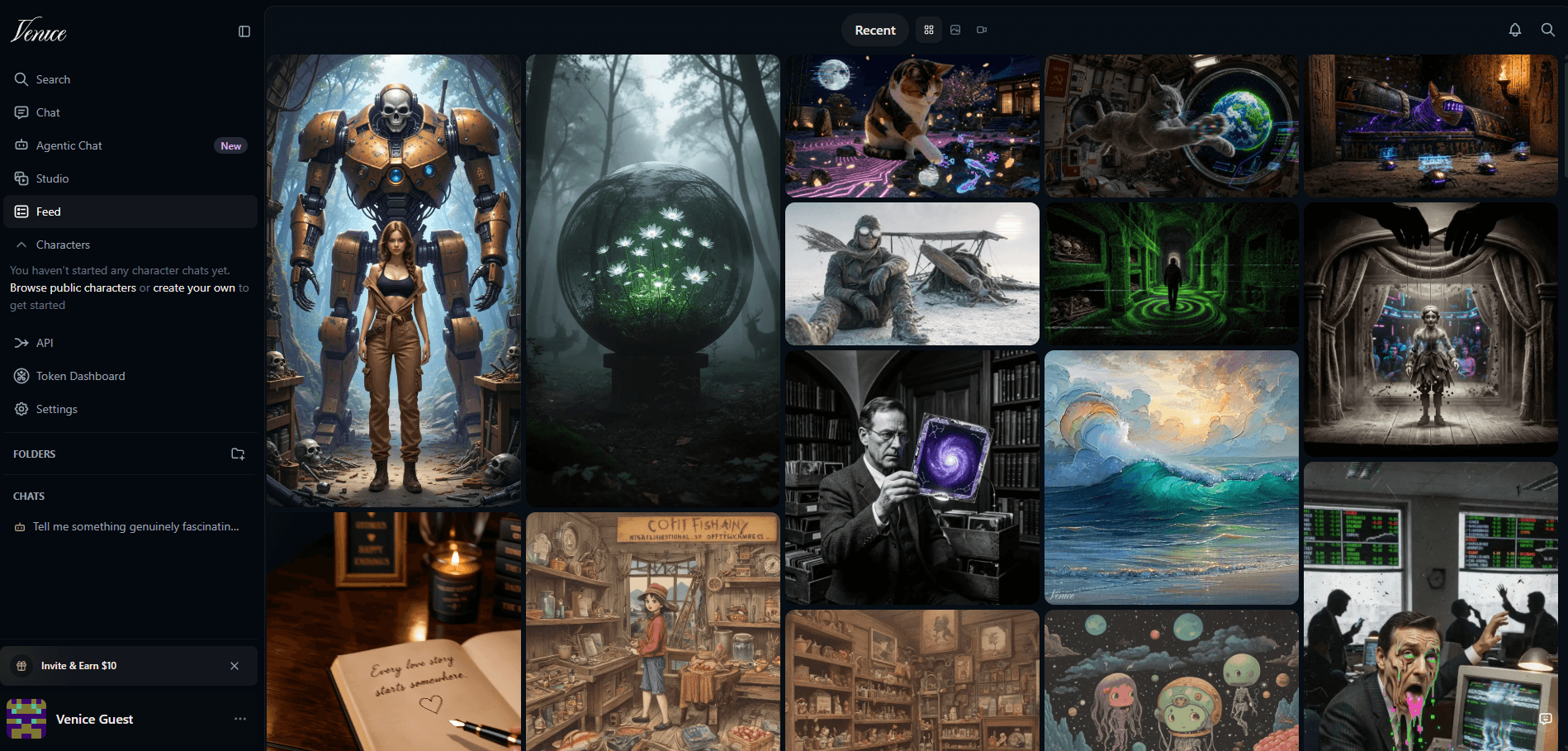
AI feed interface on Venice, Source: Venice.ai
So, Is This the First Real Crypto AI Product?
Venice makes one of the strongest cases to date. What sets it apart is that the product stands on its own. You can use Venice without owning any tokens, connecting a wallet, or even knowing how the tokenomics work.
The crypto layer is optional and becomes relevant only if you want to stake, access API credits, or participate in the platform's economics.
Many crypto projects launched tokens first and hoped a product would follow. Venice built a functioning product, attracted users, and only then introduced a token designed to capture the value created by the platform.
The Takeaway
Venice is getting attention because it combines something rare in crypto: a useful product, real users, growing revenue, and token mechanics that are directly tied to platform demand.
It does not claim to have invented the best AI models in the world. Instead, it focuses on delivering a clean user experience, strong privacy protections, and an economic model that rewards adoption.
In a sector where many AI projects have struggled to move beyond narratives, Venice has demonstrated that there is genuine demand for what it offers.
Whether VVV is still an attractive investment at current prices is a separate question. But if the broader question is whether crypto has finally produced a working AI product, Venice is one of the clearest examples that the answer may now be yes.
If you liked this article, it’s time to level up. Get the Best Free Crypto Newsletter now! Insightful. Curated. Essential ~ The Beluga Brief.
Join the Beluga Brief
Dive deep into weekly insights, analysis, and strategies tailored to you, empowering you to navigate the volatile crypto markets with confidence.
Never be the last to know
and follow us on X