STRATO: The Next Big RWA Play? Meet the Chain Bringing Gold, Silver & DeFi Together
If you're exploring promising projects ahead of the next major market cycle, STRATO is definitely one to DYOR before it gets more attention.

Introduction
Crypto has spent years trying to bring real-world assets on-chain, but most projects have focused on simply tokenizing assets and making them tradable. What if you could actually put those assets to work?
That's the idea behind STRATO, a Layer 1 blockchain building an entirely new category called HardFi.
So, what exactly is STRATO?
Think of STRATO as a financial ecosystem built around hard assets.
At its core, it is an Ethereum-compatible Layer 1 blockchain designed to bring tokenized precious metals and other real-world assets into DeFi. Through a single application, users can access tokenized gold, silver, crypto assets and stablecoins without having to jump between multiple platforms.
But the interesting part is what comes next.
Users can:
- Own tokenized assets: Buy and hold gold and silver through GOLDST and SILVST.
- Unlock liquidity: Borrow USDST against supported collateral without selling their underlying assets.
- Trade assets: Swap and trade supported tokens through the platform.
- Earn: Access savings products, liquidity pools and yield strategies.
- Build: Developers can leverage STRATO's infrastructure, APIs and smart contracts to create new financial applications.
Its native stablecoin, USDST, is minted against collateral, while GOLDST and SILVST represent tokenized gold and silver backed by physical reserves.
Why STRATO Is Different From Another Crypto Chain
The RWA narrative isn't new. We've already seen projects tokenize everything from government bonds to real estate and precious metals.
However, STRATO is taking a slightly different route.
Rather than building another marketplace where users simply buy and sell tokenized assets, it is building the underlying blockchain infrastructure and financial applications that make these assets useful.
Consider GOLDST. Holding tokenized gold gives you exposure to the price of gold. But STRATO takes things further by allowing supported collateral to be used to mint USDST, unlocking liquidity without necessarily having to sell your gold.
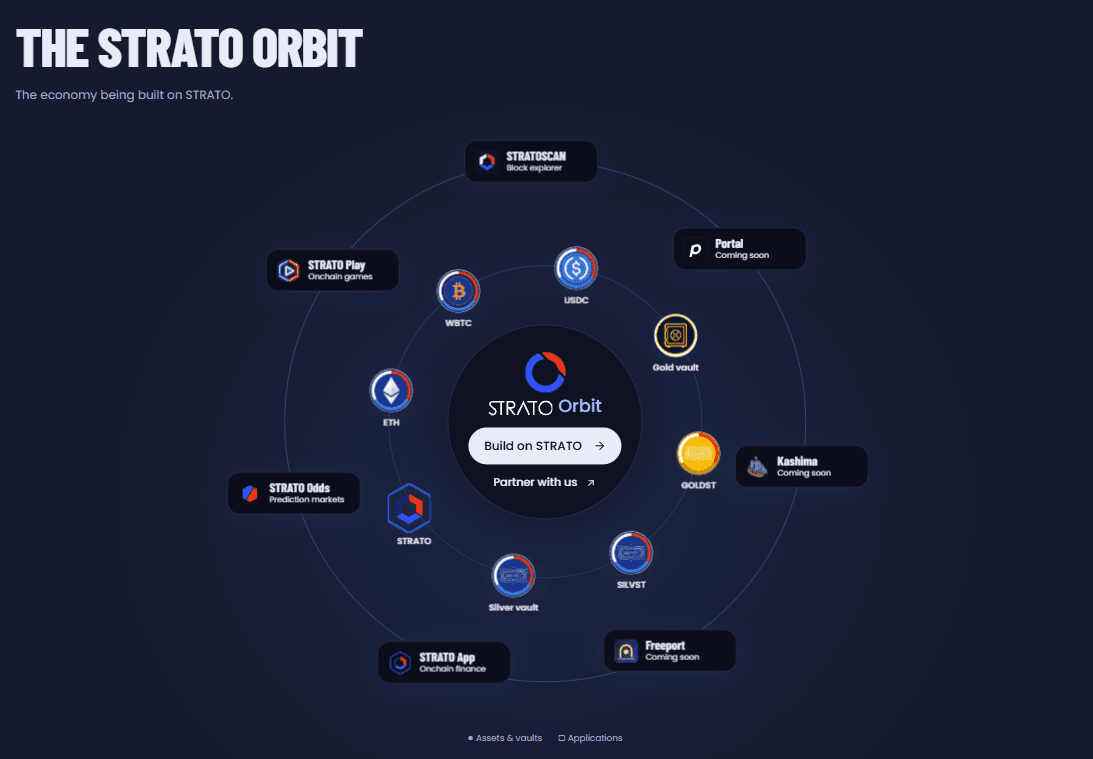
The same idea extends to silver and supported crypto assets.
Also, STRATO uses its own SolidVM smart contract environment, PBFT-style consensus and Ethereum-style transaction interfaces. It also charges a flat transaction fee of 0.01 USDST rather than relying on fluctuating gas prices.
This combination of hard-asset collateral, on-chain credit and dedicated blockchain infrastructure is what makes the HardFi approach interesting.
Meet the Strato Team
One of STRATO's biggest selling points is the people behind it and here's exactly why:
The project is led by Kieren James-Lubin (CEO), Victor Wong (CPO) and Jim Hormuzdiar (CTO), all of whom have been involved in Ethereum infrastructure since 2014.
Their experience goes back to the early days of Ethereum, when they worked on one of the original six mainnet-compatible Ethereum clients, built blockchain infrastructure with Microsoft Azure and helped establish the Enterprise Ethereum Alliance. That's a pretty impressive background for a team building a new blockchain.
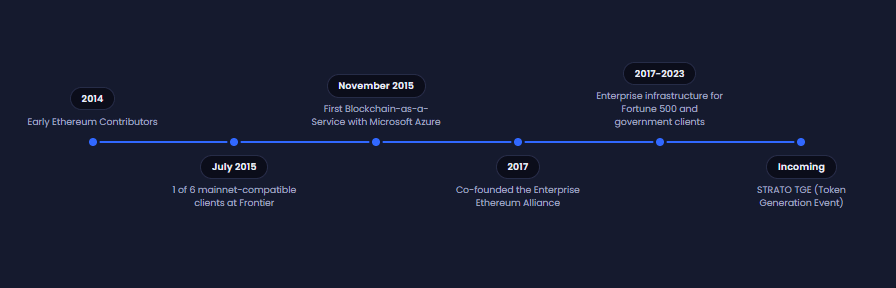
STRATO also has Joe Lubin as an advisor. For anyone unfamiliar, Lubin co-founded Ethereum and went on to establish ConsenSys, the company behind MetaMask and Infura.
Backed by some serious names
A strong team is one thing, but institutional backing adds another layer of credibility.
Developed by BlockApps, which has raised roughly $50 million, STRATO is backed by some of the most noted VCs in the space.
Its reported investors include:
- ConsenSys Mesh
- Galaxy Ventures
- Fenbushi Capital
- Morgan Creek Capital
- Bloccelerate
- Liberty City Ventures
What About $STRATO?
Of course, the native token is another reason the project deserves attention.
$STRATO is designed to be the economic backbone of the ecosystem, connecting network participants through three primary utilities:
- Gas: The planned native payment token for network transaction fees.
- Staking: Used by validators to secure the network, with delegation rewards for holders.
- Governance and benefits: Intended to give holders a say in protocol decisions and provide benefits such as lower borrowing fees.
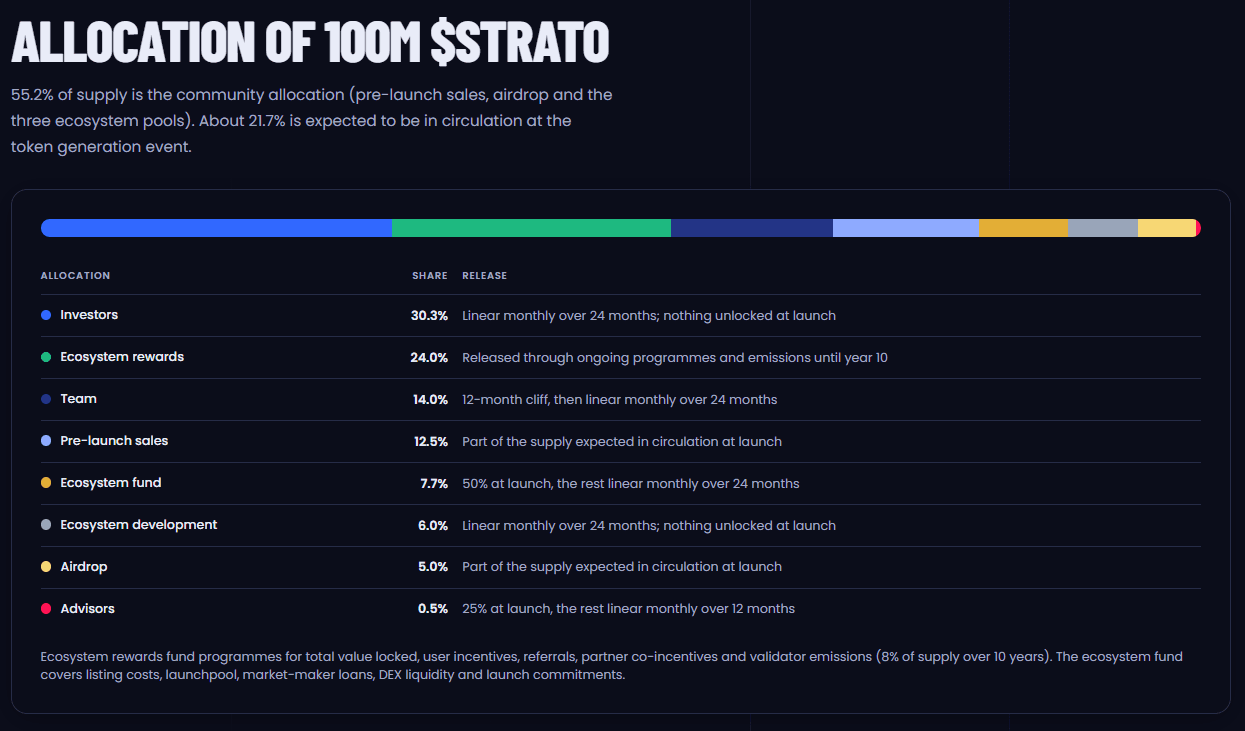
The token has a fixed maximum supply of 100 million, with 55.2% allocated to the community across pre-TGE sales, airdrops and ecosystem initiatives.
The native token issuance is currently expected in Q4 2026, making the coming weeks an important period to watch for official announcements.
Another interesting aspect is its rewards program. Users can earn points through eligible ecosystem activities, including liquidity provision, borrowing, savings and bridging. These programs are designed to connect early ecosystem participation with the upcoming token launch.
Look for a deeper dive into this topic in a future piece.
One important distinction: some $STRATO utilities are still rolling out. Staking for rewards is already live on mainnet, stake-weighted consensus switches on at a scheduled network upgrade, and paying gas in $STRATO is still planned. Today, transactions cost 0.01 USDST or one voucher. So the token’s full utility model is something to watch as TGE approaches.
Why STRATO could be one to watch
The bigger opportunity here is the intersection of two narratives that could become increasingly important in crypto: RWAs and DeFi.
Gold and silver have traditionally been viewed as stores of value. STRATO is betting that putting these assets on-chain can unlock an entirely new financial layer around them.
And it isn't stopping at precious metals. Its broader ecosystem includes applications such as STRATO Odds, STRATO Play and STRATOSCAN, alongside infrastructure for developers and cross-chain integrations.
This gives STRATO room to grow beyond a single product or token. If adoption picks up, the network could become an ecosystem where real-world assets, crypto liquidity and on-chain financial applications work together.
If you're exploring promising projects ahead of the next major market cycle, STRATO is definitely one to DYOR before it gets more attention.
If you enjoyed this article and want to learn more about what STRATO is building, follow them on X for the latest updates!
Never be the last to know
and follow us on X
Related Articles
All articles
What Are Smart Contracts?
This article explores the role of smart contracts in revolutionizing digital agreements, highlighting their benefits, challenges and use cases.

AERO vs UNI: Is DeFi's Next DEX Battle Going Multichain?
Aero is betting on multichain expansion while Uniswap aims to capture more trades through aggregation

Anthropic Voided $1.5 Trillion in Tokenized Equity. It Was Only Ever Backed by $23 Million.
The first real stress test of crypto's pre-IPO market just landed, and the SPV-backed tokens failed it.

The Most Important Crypto Founder You've Never Heard Of
If you’ve been in crypto for a few years and that name doesn’t ring a bell, you’re not alone… but in the world of fintech, Cagney is a legend with one of the most compelling founder arcs in the industry.

Beluga's 10 Predictions for 2026
2025 was a wild ride and 2026 is gearing up to be just as crazy.
What Is Real World Asset (RWA) Tokenization?
This article explores the revolutionary potential of RWA tokenization, highlighting its benefits, challenges and notable industry players shaping the future of the space.