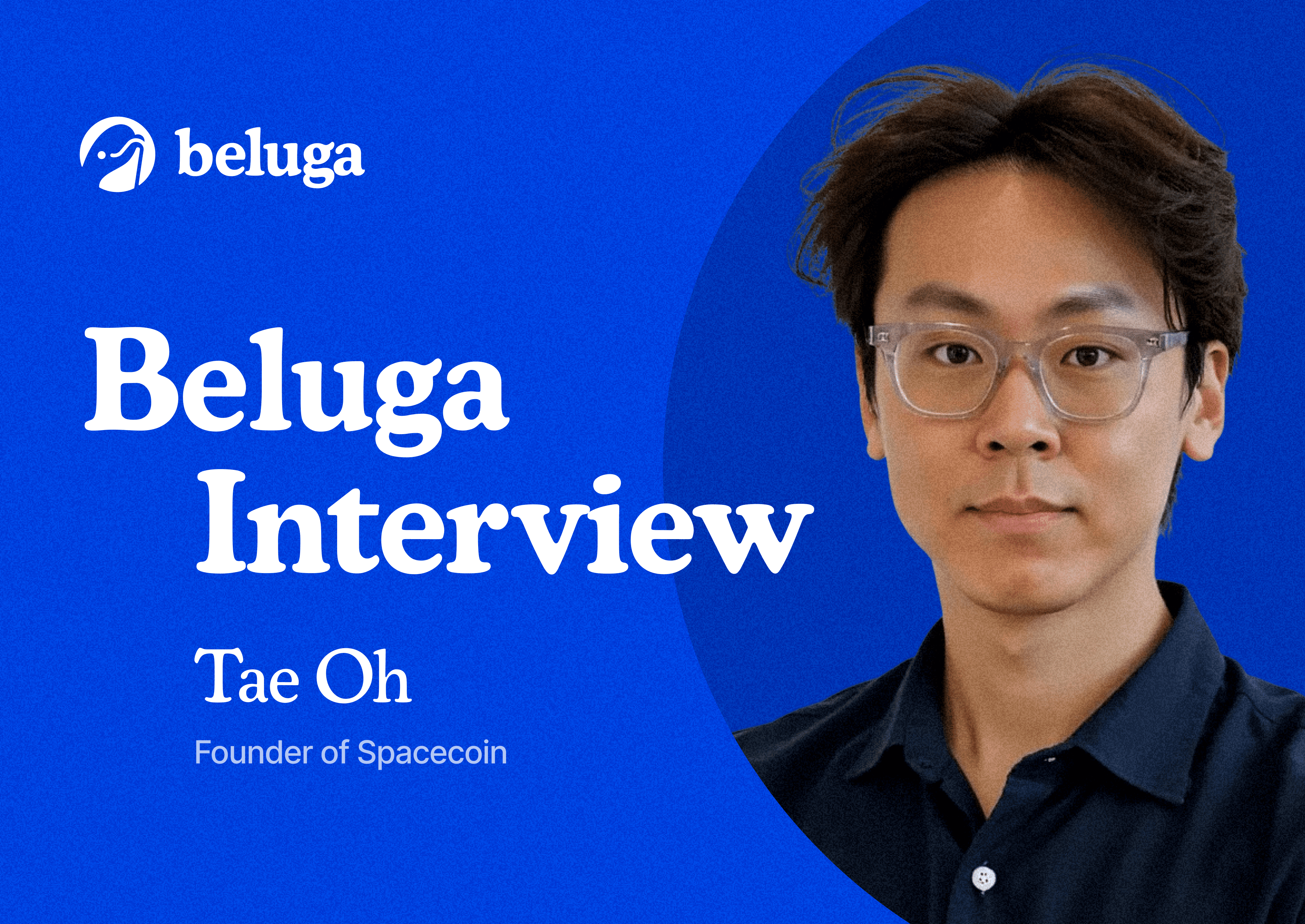
Beluga Spotlight: Tae Oh, Founder of Spacecoin
By Will McKinnon Updated December 18, 2025
Summary
- This week Beluga sat down with Tae Oh, the founder of Spacecoin, to discuss how he plans to deliver internet connectivity to over 2.5 billion people around the world
About Tae
Tae Oh is the founder of Spacecoin, the world’s first decentralized physical infrastructure network (DePIN) powered by low-Earth orbit (LEO) satellite constellations. Built to serve as the open protocol for permissionless, global internet connectivity, Spacecoin uses blockchain-enabled satellites to bring decentralized access to underserved communities worldwide.
Tae also serves as the founder and CEO of Gluwa, Spacecoin’s development company, aligning its connectivity mission with Gluwa’s longstanding focus on financial inclusion. Prior to Spacecoin, Tae founded Creditcoin, a Layer 1 blockchain that has facilitated millions in on-chain microloans for underbanked populations across emerging markets while building credit histories.
At Spacecoin, Tae is carrying that mission of inclusion forward into the digital access space. In December 2024, Spacecoin launched its first satellite, CTC-0, which accomplished its mission of sending a blockchain transaction from Earth to space and back. In November 2025, Spacecoin launched its first satellite constellation, CTC-1, which consisted of 3 satellites that will test inter-satellite linking.
Questions & Answers
1. Congratulations as you just successfully launched 3 satellites into space on Nov 28th. What was that like?
The greatest feeling was the launch of CTC-0, our first satellite, because it was new. I had never seen a rocket launch before, and there's something about the novelty of it all. It gives you goosebumps. What SpaceX has accomplished in the rocket industry is truly incredible, so witnessing it firsthand was truly awe-inspiring.
And that feeling never gets old. CTC-1's launch was another incredible experience because now our mission deepens. The first satellite mattered a lot, but these next three help give us an even bigger leap into making our crazy mission into a reality.
2. What are these satellites doing and what is the ultimate mission?
The CTC-1 constellation represents a major milestone in our journey to build a decentralized internet in space.
Before going into the CTC-1 mission, I want to quickly reference our first CTC-0 satellite mission. With CTC-0, our first satellite, we proved that we could transmit an end-to-end blockchain transaction from Earth to space and back (the world’s first!). This opens up the world of financial transactions via a truly decentralized and private internet network.
Now, with three satellites working together as CTC-1, we're testing how these systems scale and operate as a network in orbit. We're focused on providing two key capabilities: seamless connectivity, ensuring user connections stay stable as satellites move across orbit, and inter-satellite links, enabling satellites to exchange data directly with minimal reliance on ground stations.
Our ultimate mission is to establish an open protocol for decentralized connectivity infrastructure. We're building a permissionless internet in orbit. One that is more resilient, private, and impossible to switch off. This is about making internet access a basic human right for everybody everywhere, especially the 2.6 billion people globally who still lack connectivity.
3. You often talk about the internet as a basic human right. With Spacecoin, you're building a decentralized, censorship-resistant network in space that nobody can turn off. Could you share what drives this mission personally? Why is the fight for digital freedom so important that you decided to take it to space?
Throughout my childhood and adult life, I’ve witnessed firsthand how access to information and connectivity shapes opportunities. Sure, the internet has entertainment, but more importantly, it's about access to education, financial services, healthcare information, and the ability to participate in the global economy.
Yet billions of people are still excluded from this fundamental resource, either because of geography, infrastructure limitations, or government restrictions.
What drives me is the belief that no person, no government, no corporation should have the power to decide who gets to connect and who doesn't. Traditional internet infrastructure is centralized and vulnerable—it can be shut down during natural disasters, censored by authoritarian regimes, or simply never built in regions that aren't profitable enough for telecom companies.
When I discovered Bitcoin in my senior year at Carnegie Mellon, I became fascinated with the concept of borderless, permissionless systems. That philosophy led me to found Gluwa to bank the unbanked. Now, with Spacecoin, we're taking that same principle to connectivity itself. By putting our infrastructure in space, we're creating a network that operates beyond the reach of any single authority.
The fight for digital freedom is so important because connectivity is the foundation for everything else. You can't access decentralized finance if you can't get online. You can't build on-chain credit if you're disconnected. You can't participate in the global digital economy if someone can flip a switch and cut you off. It's the only way to truly guarantee that internet access remains a human right.
4. How much planning was involved as you probably can't just call up SpaceX the night before and book your cargo?
The planning involved is absolutely immense! You're right, you can't just call up SpaceX the night before and book a slot on a rocket!
In reality, you have to pre-plan at least a year in advance, sometimes even longer depending on the mission requirements and launch availability.
The process involves multiple layers of complexity. First, there's the satellite design and manufacturing phase, where you're working with engineers to build hardware that can survive the extreme conditions of launch and operate reliably in the harsh environment of space. Every component has to be tested and retested because once it's up there, you can't exactly send a technician to fix it.
Then there's the regulatory approval process. We had to secure all the necessary licenses and approvals from regulatory bodies. This involves demonstrating that our satellites won't interfere with other space operations, that we have proper frequency allocations, and that we meet all safety and operational standards.
Coordinating with the launch provider is another major undertaking. SpaceX's rideshare missions are incredibly popular, so you're competing for limited cargo space with other companies and organizations. You have to submit detailed specifications about your payload's weight, dimensions, and deployment requirements well in advance.
Then there are the pre-launch preparations, like having our satellites pass final health assessments, as our CTC-1 satellites did at Vandenberg Space Force Base before their November launch.
All of the above leads us to finally being able to properly launch into orbit. It was a big undertaking, so shout out to our launch partners for helping us along the way!
5. Does Spacecoin need to launch a ton of satellites to achieve its goal of providing internet to billions of people?
No, and that's one of the most exciting aspects of our approach. We don't need to launch thousands of satellites ourselves because we're building an open, permissionless network. Our strategy is fundamentally different from traditional satellite internet providers.
We plan to open source our satellite design so that anybody can build and launch satellites on our network. This democratizes access to space infrastructure and allows the network to scale organically. Instead of being the sole operator bearing all the costs and complexity, we're creating a protocol that enables others to participate and contribute.
Additionally, existing satellite operators will be able to join our permissionless network to capitalize on utilizing their satellites more efficiently and generate additional revenue. Many satellite operators have underutilized capacity, and by joining the Spacecoin network, they can tap into a new market and revenue stream without having to build entirely new infrastructure.
This approach embodies the true spirit of decentralization. Rather than creating another centralized satellite constellation controlled by a single company, we're building the protocol layer that allows a diverse ecosystem of satellite operators to interoperate and provide connectivity.
By having third parties deploy satellites that interoperate with our network, it will accelerate coverage expansion and ensure that the network can scale to serve billions of people without requiring us to launch every single satellite ourselves. It's a more sustainable, decentralized, and ultimately more powerful way to achieve our mission.
6. You've built successful, community-driven projects like Creditcoin before. How has your past success shaped your belief that a community, rather than venture capitalists, is the right way to build something as ambitious as a new internet?
Building Creditcoin taught me an invaluable lesson: when your mission is to serve the people, the people should be part of the journey from the beginning. Creditcoin's success came from creating real utility for underserved communities: helping the unbanked build on-chain credit and access financial services they were previously excluded from.
That experience fundamentally shaped how we're approaching Spacecoin. When you take venture capital, you're often pressured to prioritize short-term metrics, rapid user acquisition, and exit strategies over long-term mission alignment. VCs have their own timelines and return expectations, which can force you to make decisions that benefit investors rather than users. For something as ambitious as building a new internet in space, which frankly speaking is a mission that requires patience, long-term thinking, and unwavering commitment, you need to really have the right partners for the journey.
7. We've heard you mention that you can be a degen with Spacecoin's operations. What does that even mean?!
Ha! Yeah, being a "degen" with Spacecoin is definitely a unique concept, and it's one of the most exciting aspects of how our network operates.
So, for most regular users, accessing the Spacecoin network will be straightforward. They'll pay their local telecommunications provider in fiat currency, just like they do for internet service today. Behind the scenes, that provider will use SPACE tokens to interact with the Spacecoin network on the user's behalf. It's seamless and familiar.
But if you're more technically advanced—if you're a true degen—you can take things to the next level. You can set up your own ground station and connect directly to the network, bypassing any middlemen entirely. Instead of paying a telecom provider, you spend SPACE tokens directly to get connected to our satellites. This gives you complete control over your connectivity!
Here's where it gets really interesting: as a degen with your own ground station, you can configure the network in advanced ways. For example, you can assign a couple of satellites for a dedicated connection between two specific points. This means you could potentially have a faster, more reliable internet connection than anyone else in your region because you're using dedicated satellite resources rather than sharing bandwidth through a traditional provider.
It's the ultimate expression of permissionless infrastructure. You're not asking anyone for permission to connect. You're not relying on a corporation to provide service. You're directly interacting with satellites in orbit using cryptocurrency, and you have the flexibility to optimize your connection however you want.
This model appeals to developers, crypto technologists, businesses that need guaranteed connectivity, and anyone who values sovereignty over their internet access. It's also a glimpse into the future of how space infrastructure can work: open, programmable, and accessible to anyone with the technical know-how and willingness to participate directly.
Quite exciting in my humble opinion!
8. The upcoming SPACE token launch is a huge milestone. You've partnered with Blockchain.com, giving millions of people access from day one. For the person at home who's inspired by your mission, what role does the SPACE token play in the ecosystem? How does holding the token allow them to become an active participant in building this new internet, rather than just a passive user?
The SPACE token launch will indeed be a massive milestone, but while most projects see TGE as the end-goal, it is only the beginning for us. We want millions of people to learn about our mission, so by partnering with Blockchain.com means that their massive network of users will have access to participate from day one.
So, what role does the SPACE token play? At its core, the SPACE token is the native utility cryptocurrency of the Spacecoin ecosystem. It's what powers the entire network. When someone wants to access internet connectivity through our satellite constellation, they pay for that service using SPACE tokens. This creates real, tangible utility, not speculation. It’s the fuel that makes the network run.
In addition, node operators who wish to join the network, from mega telecos to satellite operators, they will need to acquire SPACE tokens in order to participate in internet data processing and other commercial activities.
9. Did you ever imagine growing up that you would be launching satellites as you had quite the childhood moving around?
No, I didn't think I was this crazy, haha!
I was always curious about the world and fascinated by technology, but launching satellites into space? That wasn't exactly on my childhood vision board.
I think what my nomadic childhood did teach me though, was the importance of connectivity. When you're constantly moving between different countries and cultures, you realize how much access to information and communication shapes your opportunities. The internet became a constant in my life even as everything else was changing.
Looking back, maybe it makes sense that someone who grew up crossing borders and experiencing different systems would eventually become obsessed with building borderless, permissionless infrastructure. But satellites? That's definitely taking it to a level I never imagined, but I simply seized the opportunity when I saw it was a viable option.
So no, younger me would probably be shocked. But I think he'd also be pretty excited.
10. Do you want to go to space one day?
Don't we all?
There's something profoundly inspiring about the idea of seeing Earth from orbit, experiencing weightlessness, and witnessing firsthand the infrastructure we're building up there. If the opportunity arose, absolutely, I'd love to go to space!
Liked this interview? Follow Spacecoin on X to learn more about their mission!
Join the Beluga Brief
Dive deep into weekly insights, analysis, and strategies tailored to you, empowering you to navigate the volatile crypto markets with confidence.
Never be the last to know
and follow us on X