Why the World’s Biggest Payment Companies Are Building on Polygon
By Pratik Bhuyan Updated April 1, 2026

Summary
- Polygon is evolving from an Ethereum scaling solution into a foundational layer for Web3 finance with a clear focus on moving global money onchain
- Major partnerships with Revolut, Stripe, and Paxos are enabling fast low cost stablecoin payments at real world scale
- Consumer and institutional adoption is accelerating as platforms like Polymarket drive user activity while Apex Group brings massive tokenized asset commitments
Introduction
Polygon, once known simply as an Ethereum scaling solution, has been undergoing a massive transformation. The project is now laser-focused on a singular, ambitious mission: moving all money on chain. This isn't just marketing speak. When you look at what they’re building, it becomes clear that Polygon is positioning itself as a foundational layer for the future of Web3 finance, rather than just another blockchain.
Payments Are Finally Becoming Real
If you’ve ever sent money across borders or waited days for a bank transfer to clear, you know the system is broken. It’s slow, expensive, and opaque. Stablecoins offer a solution, but integrating them into real-world business operations has always been a challenge. Polygon is solving this by partnering directly with the world’s leading fintech platforms.
Revolut
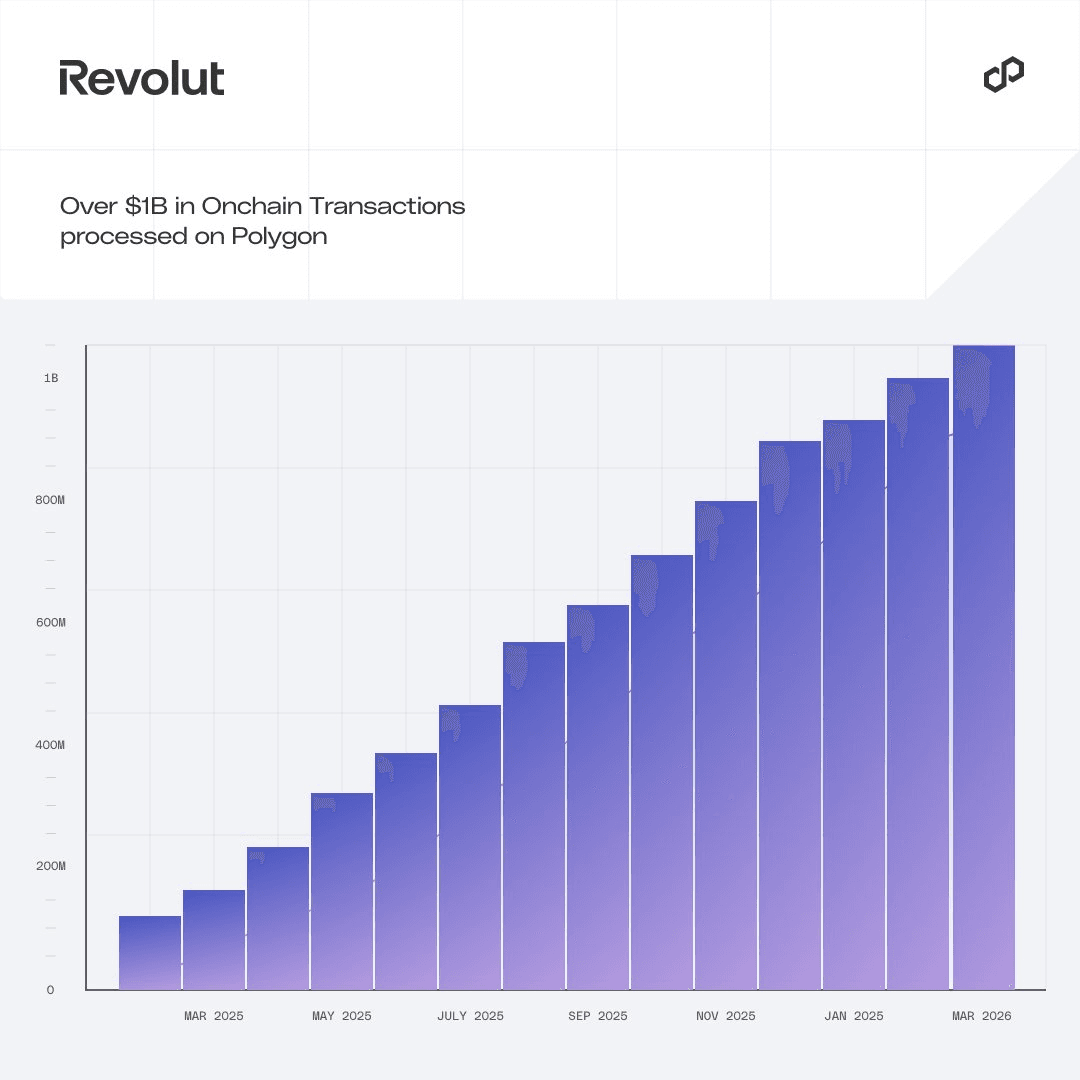
Take Revolut, for instance. Europe’s largest neobank with over 65 million users, selected Polygon as its go-to stack for stablecoin transfers and payments. This integration allows millions of users to move money with near-instant settlement at a fraction of the cost of traditional rails. The numbers speak for themselves: in 2025 alone, Revolut moved over $1.2 Bn in volume through the Polygon network.
Stripe
Then there is Stripe, the payments behemoth that powers online commerce for countless businesses. Stripe has been using Polygon to enable crypto payouts, especially for freelancers and global creators. The key here is cost and speed. Polygon transactions often cost fractions of a cent while maintaining high throughput, which is critical for payments at scale. According to recent data, Stripe processed over $75 million in payments on Polygon in a recent period, and the number has only been growing.
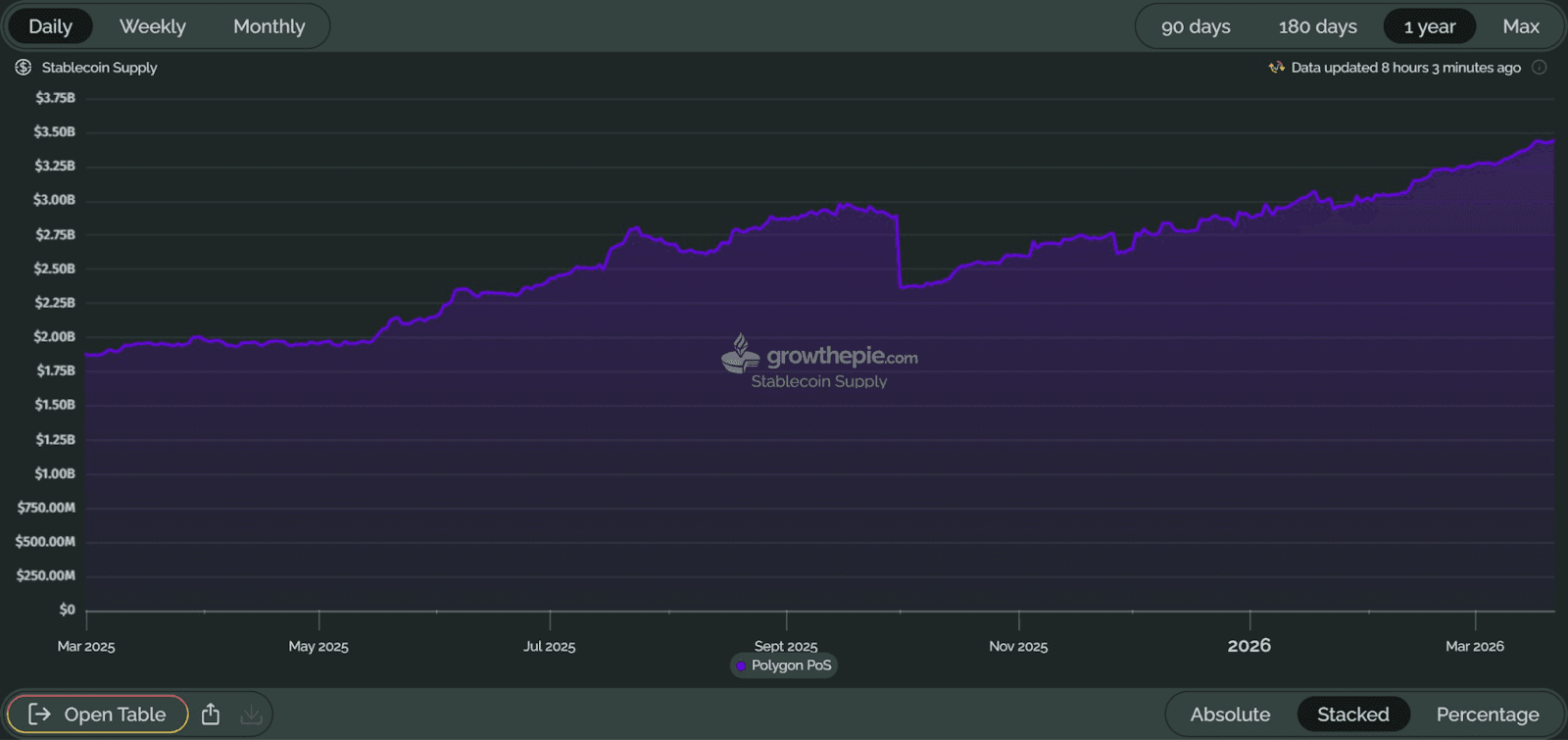 Stablecoin supply climbs to $220 Million in 1 month
Paxos
Paxos adds another layer. As a trusted issuer of stablecoins and tokenized assets, Paxos brings the kind of institutional-grade reliability that traditional companies demand. Its activity on Polygon also highlights the efficiency of onchain payments at scale, processing over $1.3 billion across 82,000+ transactions for under $700 in gas fees, which translates to a 99.998% cost reduction compared to traditional systems! Together, integrations like this have helped Polygon scale massive stablecoin usage and position itself as a leading network for real world payment flows.
Mastercard Partnership
To further cement its role in global payments, Polygon recently joined the Mastercard Crypto Partner Program, a network of over 85 companies working to connect onchain infrastructure with Mastercard’s massive payment rails.
With all things considered, Polygon is becoming the backend for stablecoin payments and global money movement, moving beyond just “crypto-native transfers”.
Marc Boiron, CEO of Polygon Labs, recently explained the vision behind these integrations. In a recent interview, he described the company’s strategy as building an “open money stack” - a vertically integrated suite of tools that includes on-ramps, wallets, and cross-chain interoperability, all accessible through a single API.
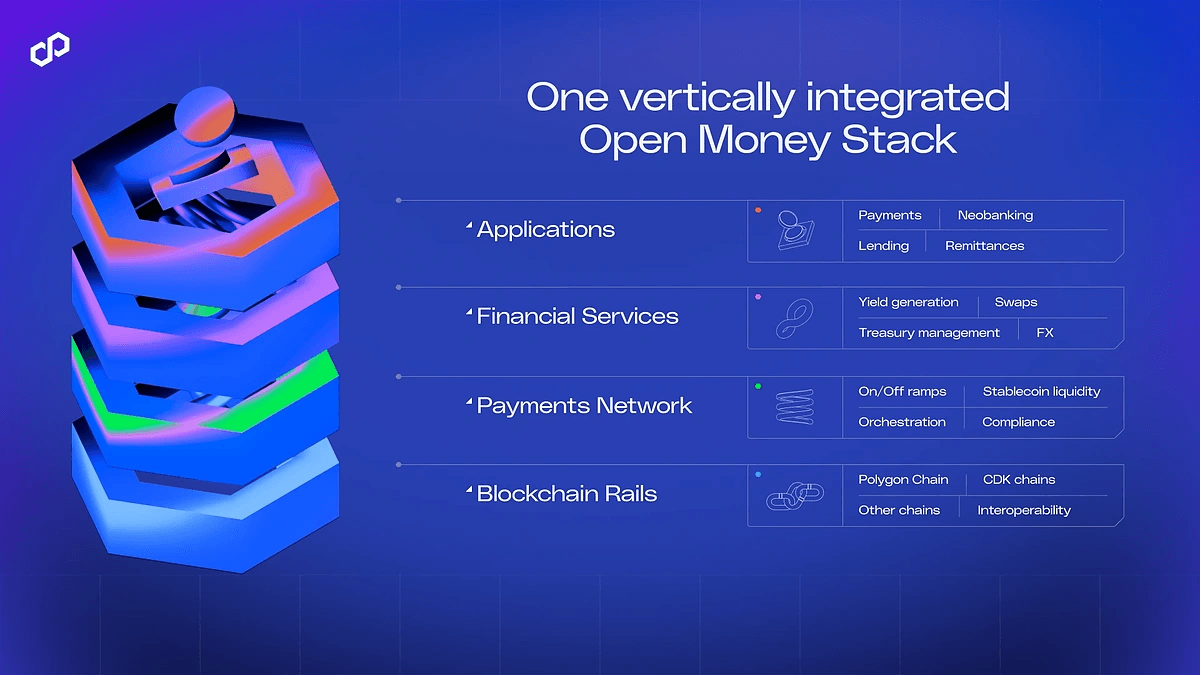 The Open Money Stack initiative
Leveraging Polymarket & Rise of Prediction Markets
Payments are one thing, but what about markets that reflect real-world events? On the consumer side, Polymarket is one of the best examples of sustained onchain activity.
It runs entirely on Polygon, and during major events like elections, the Super Bowl and the Oscars, trading activity spikes significantly. What’s interesting is not just the spikes, but the consistency. During the peak of the 2024 US election season, Polymarket saw billions of dollars in trading volume, and the underlying infrastructure handled it seamlessly.
Polymarket helped onboard an entirely new class of users who may have never touched a blockchain before but were drawn in by the ability to bet on election outcomes. And those users now have a wallet, they have USDC, and they are part of the Polygon ecosystem.
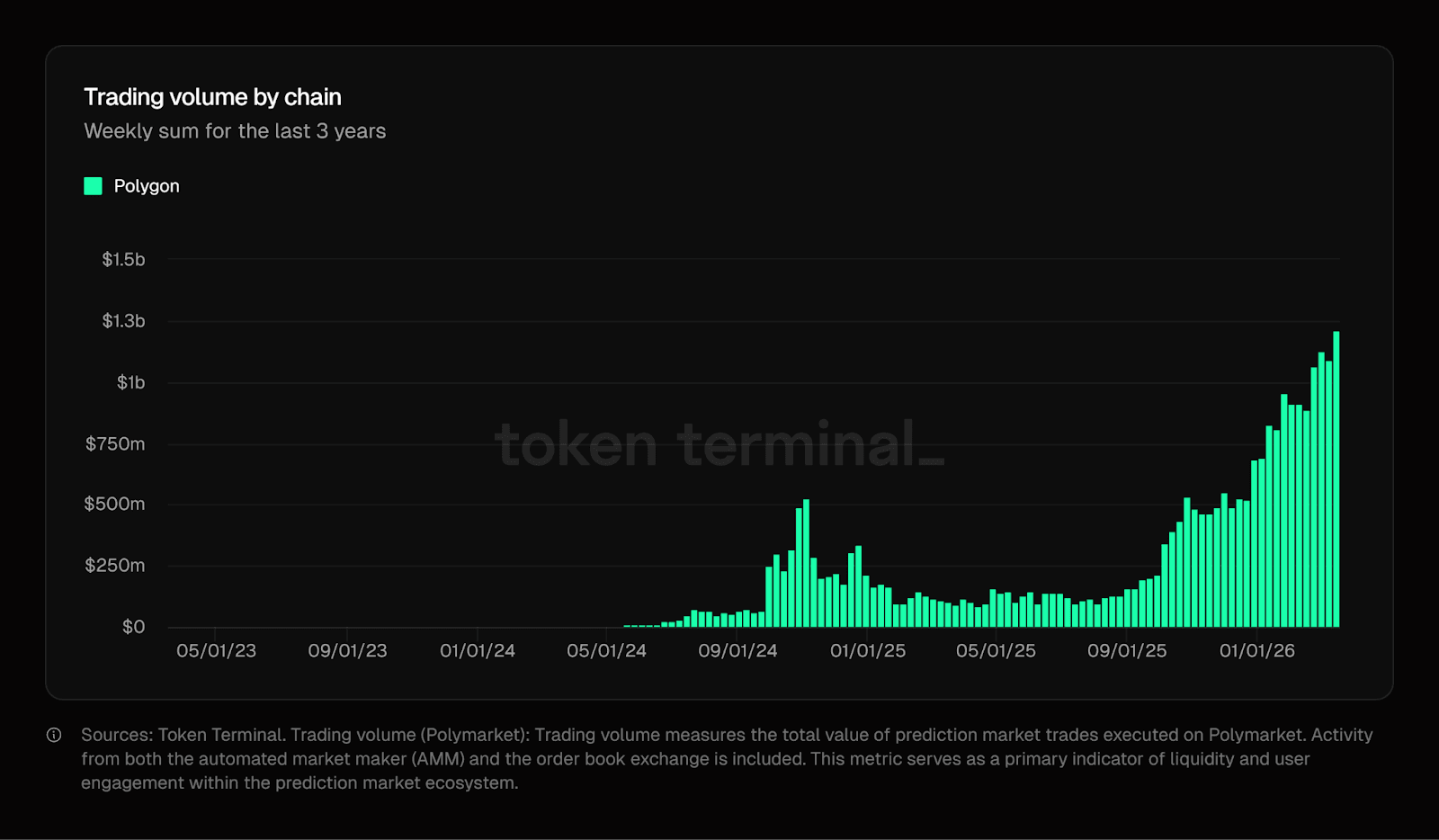 Polymarket’s trading volume on Polygon
The Institutional Frontier: Apex Group’s $100 Billion Bet
Now, on the institutional side, Apex Group, a global financial services provider managing over $3.5 trillion in assets, recently announced plans to commit a staggering $100 billion in tokenized assets to T-REX Ledger, a compliance-focused blockchain built using Polygon CDK.
So, why is this such a big deal? The T-REX Ledger solves one of the biggest headaches in the tokenization space: maintaining compliance across different blockchains. When assets move from one chain to another, information about ownership, transfer restrictions, and investor eligibility often gets lost. T-REX, built on the ERC-3643 standard (supported by over 140 institutions, including DTCC and Deloitte), embeds compliance directly into the asset and the network layer.
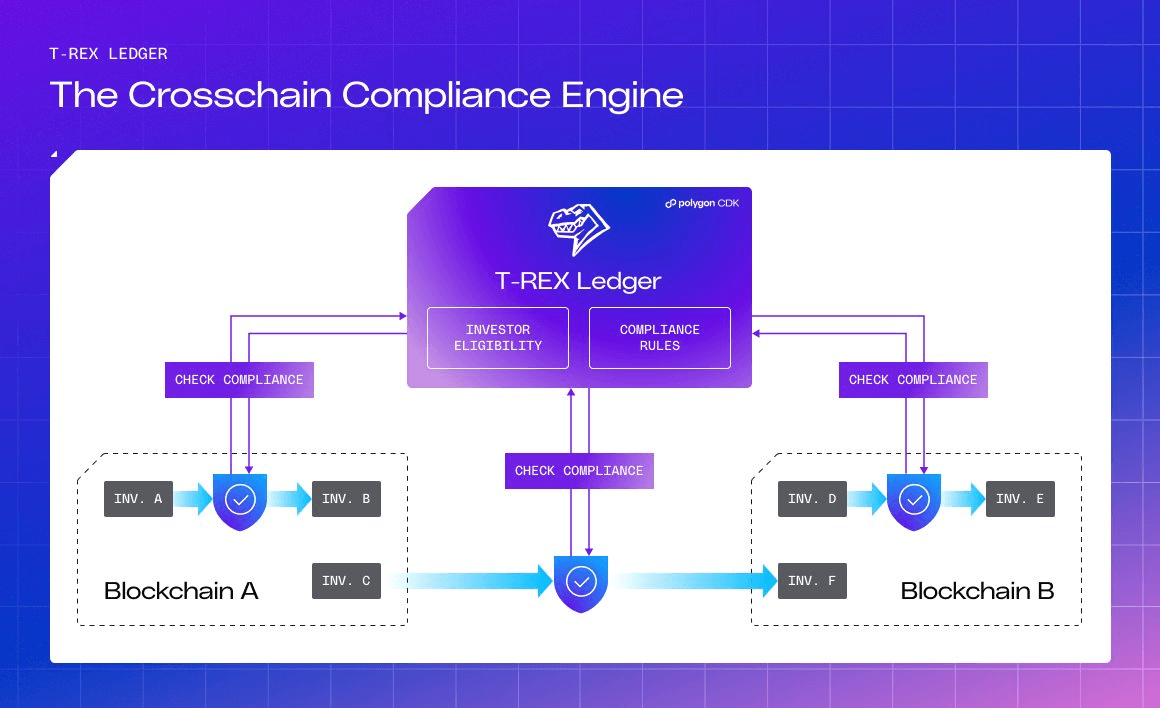
With the Agglayer, Polygon’s interoperability solution, T-REX Ledger can connect to other blockchains without sacrificing sovereignty. This means a bond tokenized on T-REX can be used in a DeFi application on another chain, but only if the transaction complies with the original asset’s rules.
It follows a pattern where the world’s largest asset managers, like BlackRock, which deployed its $500 million BUIDL fund on Polygon, are choosing the network for its security, scalability, and now its ability to handle complex compliance requirements.
Final Thoughts
What makes all of this interesting is how it fits together:
- Stripe and Paxos bring in payments.
- Revolut brings in users.
- Polymarket brings in new types of markets.
- Apex Group brings in institutional capital.
Each of these players operates in a different layer of the financial system, yet they are all choosing the same underlying network: Polygon. That convergence is what creates a powerful network effect. More payments drive liquidity. More users attract applications. More institutions bring scale and trust.
This approach is paying off. Polygon has already processed over 6.4 billion total transactions and is home to over 159 million unique wallet addresses. The long-term roadmap remains ambitious, with the Polygon Foundation targeting 100,000 transactions per second within the next few years, a capacity that would rival global payment networks like Visa.
But the real story is simpler:
When companies are building real payment systems, they are choosing Polygon.
And if that trend continues, Polygon will not just be another Layer 2. It will become part of the underlying infrastructure people interact with without even noticing.
If you enjoyed this article and want to learn more about what Polygon is building, follow them on X for the latest updates!
Join the Beluga Brief
Dive deep into weekly insights, analysis, and strategies tailored to you, empowering you to navigate the volatile crypto markets with confidence.
Never be the last to know
and follow us on X