Solana Is Winning the Meme War, But Ethereum Is Winning the Utility War
While Solana captures attention, Ethereum is building a strong case for becoming the financial infrastructure on which traditional markets move onchain.
Introduction
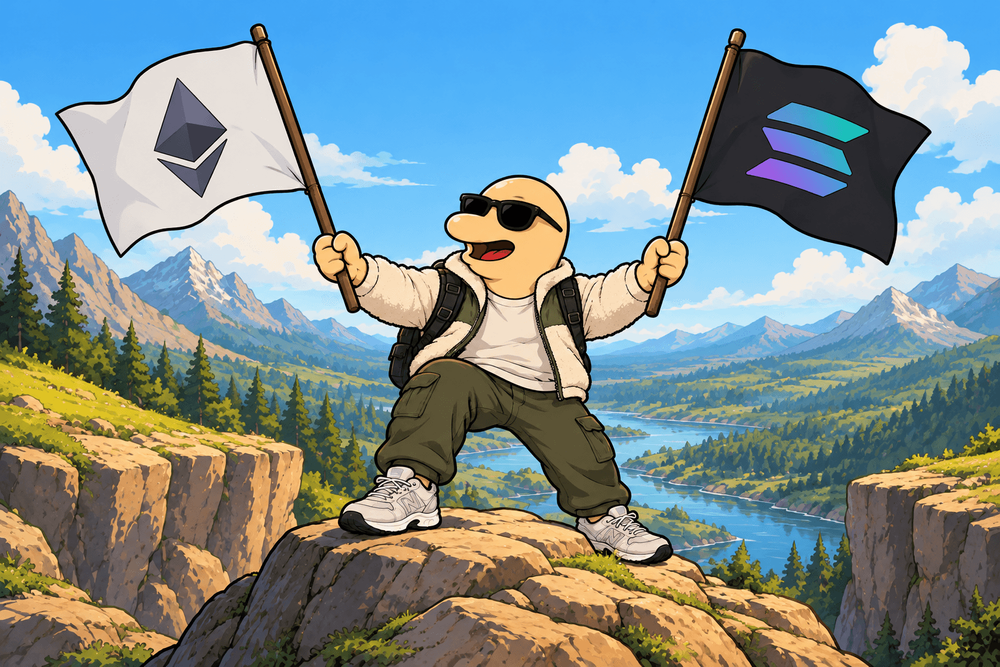
Solana has become one of crypto's best marketing machines. Cheap transactions, fast trading and a thriving memecoin culture have made it a magnet for retail traders. But while Solana captures attention, Ethereum is building a strong case for something bigger: becoming the financial infrastructure on which traditional markets move onchain.
The distinction matters because the next phase of blockchain adoption will not be decided by social media hype alone. It will depend on which networks financial institutions, businesses and developers actually rely on.
Ethereum Has the Liquidity Wall Street Needs
Ethereum's biggest advantage is its established financial ecosystem. According to Ethereum's institutional data hub, the network hosts more than 75% of tokenized real-world assets and over 60% of global stablecoin supply, based on its published figures.
Ethereum mainnet holds approximately $149 billion in stablecoins, with another $12.6 billion on its Layer 2 networks; while, reported a record $17.51 billion in stablecoin supply in September 2026.
These are not merely speculative tokens. Tokenized funds, government securities and stablecoins can support payments, settlement, collateral management and round-the-clock financial markets. BlackRock's BUIDL fund, for example, uses public blockchain infrastructure to represent ownership in a tokenized money market fund, while established DeFi protocols provide lending and trading markets for digital assets.

Ethereum's scaling strategy also matters. Networks such as Arbitrum, Optimism & Base make transactions cheaper while using Ethereum for settlement, subject to their individual security designs. Recently, Robinhood also launched its public mainnet of Robinhood Chain, an Ethereum-compatible Layer 2 built for tokenized real-world assets and financial services. It has seen the highest adoption of any new chain in a while.
Ethereum still faces challenges, including fragmented liquidity across Layer 2 networks and competition from faster alternative chains. However, its combination of stablecoin liquidity, DeFi infrastructure and institutional adoption gives it a substantial head start in onchain finance.
Solana Is Building Too..
Solana deserves credit for its technical capabilities and growing financial ecosystem. Its low transaction costs and fast execution make it attractive for trading, payments, consumer applications and RWAs. The network has a substantial developer community, established DeFi protocols and growing stablecoin activity.
However, Solana's public image has been heavily shaped by its memecoin economy. Platforms such as pump.fun made launching and trading speculative tokens accessible to almost anyone, generating considerable activity and attention.
Why Tom Lee Is Betting Big on Ethereum
Tom Lee, Fundstrat's co-founder and BitMine's chairman, has made an exceptionally bullish case for Ethereum based on these same trends.
In June 2026, Lee discussed a long-term scenario in which ETH could reach $250,000, arguing that real-world asset tokenization and AI agents could drive much greater demand for Ethereum. In August, he also argued that ETH could surpass $10,000 in 2027 or 2028, supported by a potential crypto bull market, Wall Street's adoption of tokenized assets and AI-driven activity.

The more immediate development to watch is Ethereum's continued scaling work. Its upcoming Glamsterdam upgrade is undergoing testing, with a mainnet launch targeted for Q4 2026, although no date has been confirmed. The upgrade aims to improve transaction processing and network capacity.
The Bottom Line
Solana is a serious development-focused blockchain, and its expanding financial applications deserve attention. But Ethereum's strongest advantage is the financial ecosystem already operating around it, from stablecoins and DeFi to tokenized assets and institutional infrastructure.
In the long run, the blockchain that matters most may not be the one generating the most noise today, but the one on which the next generation of financial markets is built.
Solana may be winning the marketing war, but Ethereum has a stronger claim to winning the financial-utility war. The real test is which network can turn today's crypto activity into lasting financial adoption, and Ethereum already has a substantial head start.
Want more info like this directly in your inbox? Subscribe to The Beluga Brief where we break down such trends and a whole lot more!
Never be the last to know
and follow us on X
Related Articles
All articles
What Your Favorite Blockchain Says About You
Here's how the world views you based on your favorite chain!

Altcoins That Are Worth Your Attention in 2025
President Trump's announcement of the US Digital Asset Stockpile hints at the increasing importance of certain altcoins.

How Eclipse is Bringing the Best of Solana to Ethereum
Eclipse merges Solana’s speed with Ethereum’s security, using Solana’s Virtual Machine (SVM) for fast & low-cost transactions.

The Eclipse Network and Celestia Partnership
Celestia’s role in the partnership is to provide decentralized data availability, helping Eclipse manage large-scale data securely and cost-effectively.

Will Eclipse Solve the Blockchain Scalability Problem?
Eclipse is a Layer 2 solution that aims to solve Ethereum's scalability issues by combining the strengths of Ethereum’s security, Solana's speed & Celestia’s data storage capabilities.

The State of Memecoins in 2024
Memecoins are some of the most popular things to trade in crypto, and many people join the space to gamble on them. After many years though, the space has changed from major memes like Doge to move closer to ones that pump hard and have a short lifespan.